
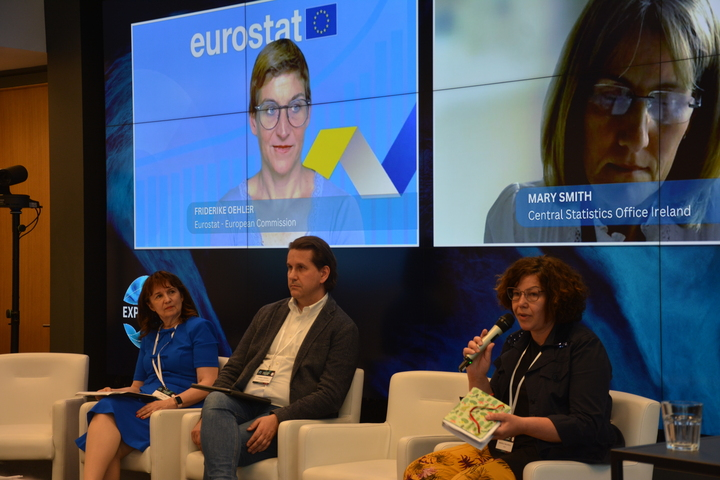
From left to right: Tiina Luige (UNECE), Dominik Rozkrut (Polish Statistical Association, IAOS), and Manuela Balzarolo (CMCC Foundation). Joining online: Frederike Oehler (Eurostat) and Mary Smith (Ireland’s Central Statistics Office).
From left to right: Tiina Luige (UNECE), Dominik Rozkrut (Polish Statistical Association, IAOS), and Manuela Balzarolo (CMCC Foundation). Joining online: Frederike Oehler (Eurostat) and Mary Smith (Ireland’s Central Statistics Office).
The SDGs-EYES project was in the spotlight at EXPANDEO 2025, the leading annual event for the Earth Observation (EO) industry in Europe organised by EARSC, during a panel discussion titled “Beyond 2030: Shaping the Future of Sustainable Development.”
Held on 12 June 2025, the session brought together high-level experts to explore the role of EO in enhancing SDG monitoring: Frederike Oehler (Eurostat), Mary Smith (Ireland’s Central Statistics Office), Tiina Luige (UNECE), Dominik Rozkrut (Polish Statistical Association, IAOS) and Manuela Balzarolo (CMCC Foundation, SDGs-EYES Project Coordinator). Marc Paganini from the European Space Agency moderated the session, opening with an emphasis on reviewing progress made so far and addressing the challenges that continue to hinder the use of EO data in national SDG reporting, especially with a look at the 2030 Agenda for Sustainable Development which underscores the critical need for data-driven and evidence-based approaches to achieve its ambitious goals and targets.
To tackle these, Manuela Balzarolo outlined in particular the efforts of the five SDGs-EYES pilots to integrate Copernicus data into national SDG monitoring systems. She highlighted the importance of combining EO data with in-situ measurements to improve indicators related to land, ecosystems, and population. She also called for stronger cross-sector collaboration to ensure EO tools remain relevant and aligned with policy objectives, a goal SDGs-EYES is driving through active user engagement.
Key highlights from the session also included:
- Geospatial data and SDGs: Panelists discussed the increasing importance of geospatial data in SDG reporting, noting its potential to enhance several SDG indicators. Collaboration with organisations like FAO was highlighted as crucial in addressing environmental issues such as deforestation, contributing directly to SDGs like climate action and life on land.
- Cost efficiency and EO institutionalisation: Panelists also emphasised the cost-efficiency of using EO in SDG statistics, particularly in agriculture. They urged for the institutionalisation of EO, moving beyond pilot projects to build sustainable partnerships that would ensure long-term use of EO in SDG monitoring.
- Challenges in EO data integration: Despite EO’s contribution to expanding geographic coverage for SDG indicators, challenges remain in aligning its products with statistical data. Issues such as mismatches in classification systems and the stability of time series data were identified as barriers to effective SDG monitoring.
- International collaboration for SDG data: Experts also called for stronger international cooperation to ensure EO data is effectively integrated into national statistics. The development of shared standards and tools was seen as essential for improving SDG monitoring and enhancing interoperability between EO and statistical systems.
Overall, experts reiterated that high-quality EO data, particularly from Copernicus, must be effectively merged with statistical frameworks to enhance SDG indicators, particularly those related to land, ecosystems, and population. They further emphasised that bridging these data gaps and fostering collaboration across sectors and internationally will be crucial to meeting the SDGs in the coming decades, with EO playing an increasingly central role in driving sustainable development.
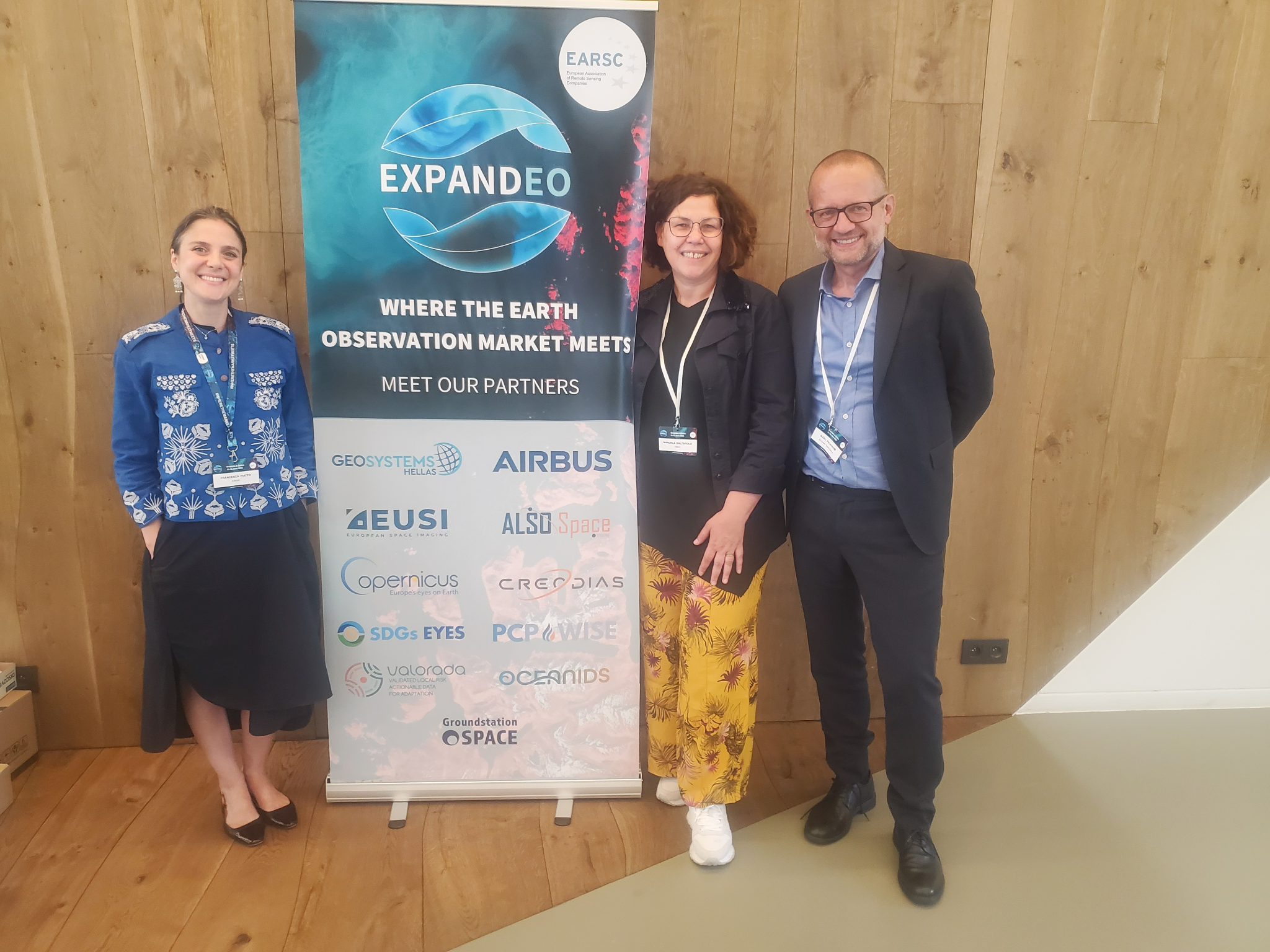
From left to right: Francesca Piatto from the EXPANDEO organising team (EARSC), Manuela Balzarolo, SDGs-EYES project coordinator (CMCC Foundation), and Marc Paganini, panel moderator (ESA).