
Heat Health Risk Assessment
Strengthening SDG 13 Monitoring to Address Climate-Related Health in Urban Areas

Pilot:
City of Turin (Italy): learn more
SDGs-EYES Heat Health Risk Assessment is a co-designed service that maps the spatial distribution of heat-related health risks in the city of Turin. By integrating Copernicus climate reanalysis data, health data, urban context and census-derived sociodemographic indicators, it produces a risk indicator that reflects climate hazard, exposure and vulnerability.
The service identifies urban areas where heat stress coincides with the presence of at-risk populations. These include elderly residents, people with limited mobility or poor housing conditions, and neighborhoods with low adaptive capacity. The result is a map-based tool that highlights where heat-health risk is highest and identifies its main determinants – at the level of individual urban census tracts – and consequently supports policy decisions such as prioritising cooling interventions or issuing heat warnings
Main Features
Heat Health Risk Assessment provides a comprehensive and scalable solution designed to monitor the relationship between extreme heat events and public health vulnerability. The service integrates multiple data streams to deliver actionable indicators for policymakers and public health authorities. At its core, the service combines climate data with vulnerability information, such as socio-economic and demographic profiles, contextual risk amplifiers, and local healthcare and social infrastructure. These datasets are processed through an automated cloud-based workflow that ensures accessibility of results.
Through stakeholder co-design sessions, local health agencies, academia, urban and environmental experts, and regional institutions contributed to shaping key parameters, such as identifying priority areas and vulnerable groups, including elderly populations and individuals with pre-existing chronic health conditions. The final product consists of:
- the codes needed to calculate the hazard indicators, and
- the interactive tool to visualise the maps of risk, hazard, exposure and vulnerability together with other geographical features useful to the user.
Users can explore interactive heat-health risk maps, graphs and download datasets that align with national and international health reporting standards.
Critically, the service’s modular architecture ensures high adaptability. It is structured in such a way that regional authorities or other implementing organisations can easily adapt the methodology using local data sources, provided they meet basic technical specifications. This supports the transferability of the service to other geographic regions and regulatory contexts. Replication is immediate for the calculation of the hazard indicators. Regarding exposure and vulnerability indicators, most of them come from open datasets while for others, especially health data, collaboration with the local health authority is needed.
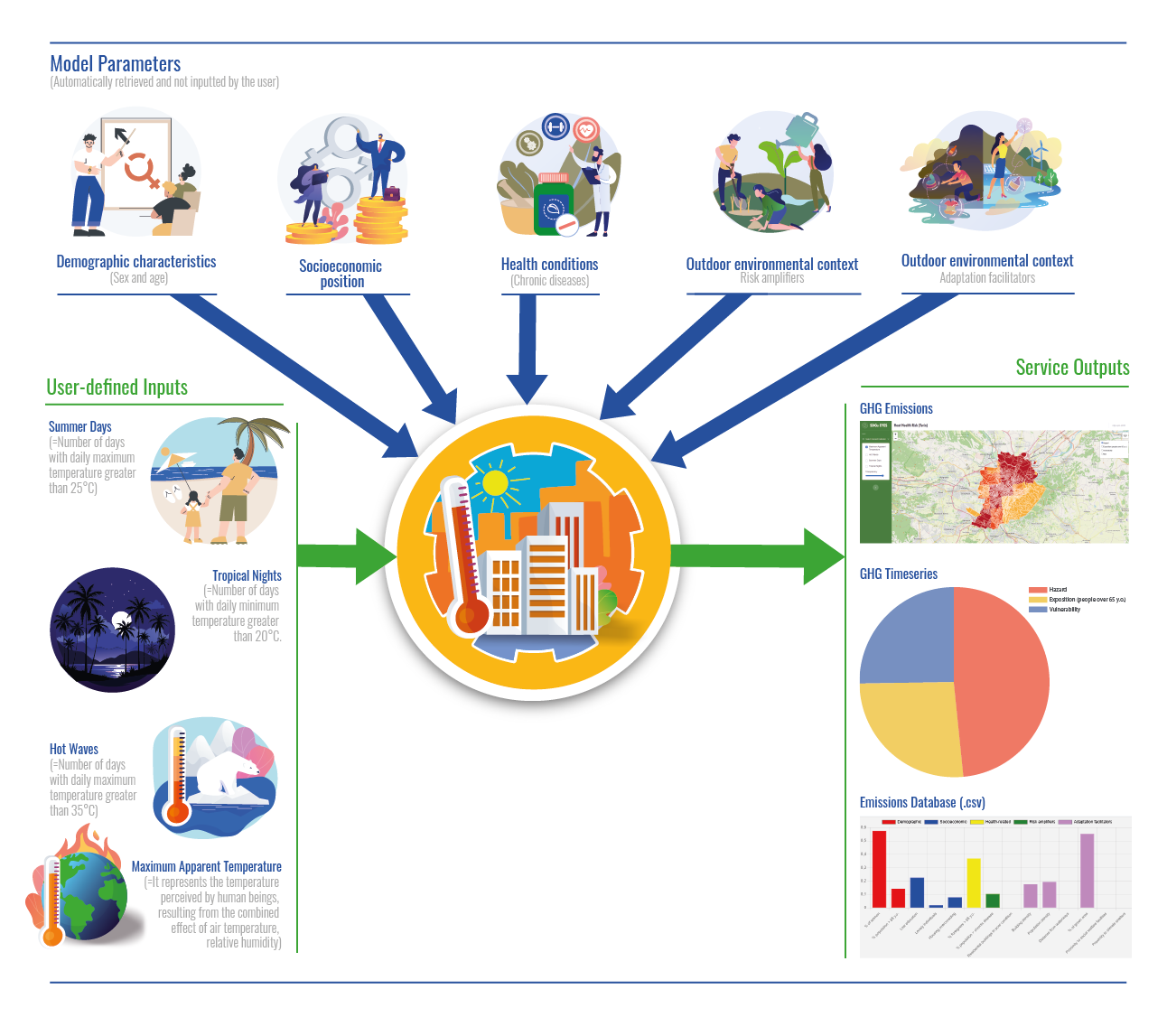
Heath Health Risk Assessment enables mapping of climate-related risks for health at the suburban level. Upon user choice of the climate indicator, the tool integrates hazard, exposure, and vulnerability in the framework of a IPCC risk model. The generated outputs allow the identification of micro-areas most at risk and of the relative impact on risk of macro-categories and each single vulnerability indicator.
Useful Resources:
- Policy Brief “Heat Health Risk Assessment: Strengthening SDG 13 Monitoring to Address Climate-Related Health in Urban Areas“
- Video Service Demonstration: click here
- Platform Guidelines: click here

The SDGs-EYES project is funded by the European Union | Credits