
Climate Security Watch
Advancing SDG Indicator 13.1.1 to Improve Disaster-Impact Assessment in the Sahel

Indicator:
- Number of deaths, missing persons and directly affected persons attributed to disasters per 100,000 population (13.1.1)
Pilot:
- Sahel countries: learn more
Focusing first on flood impacts, the Climate Security Watch service delivers a scalable Earth observation–driven platform that identifies where hazards meet human presence.
More accurate and realistic data
The Climate Security Watch: The Sahel Impact Tracker integrates multiple data sources in an automated, cloud-based workflow. Flood-related datasets (precipitation, soil moisture, and hydromodelling from digital elevation models) are combined, while exposure is represented with gridded population and building-footprint layers. A predictive ecoregion-specific model, trained and validated on documented flood events in the region, translates the intensity and extent of flooding into event-level estimates of affected people and buildings for each event, aligned with SDG 13.1.1. Outputs are delivered at operational spatial scales and are presented as tables that can be exported as digital products for further analysis or archiving.
The service’s exploitation plan identifies concrete assets for its sustainability and growth: a climate-security-adapted SDG 13.1.1 indicator, harmonised input bundles for precipitation and exposure, services and scripts for indicator calculation, validation reports and a multi-risk dashboard. Together, these assets underpin repeatable production and facilitate uptake by operational agencies.
Near-real-time data
When rainfall and river conditions indicate a flood, the cloud-based workflow can automatically ingest the latest EO and model data, update the flood potential footprint and publish near-real-time impact estimates. The web interface lets users explore spatial patterns, drill down to affected settlements and track how impacts accumulate over time. Event-triggered updates overcome delays typical of manual reporting, giving decision-makers a current, comparable picture of needs on the ground.
Co-design process
Developed within SDGs-EYES and co-designed with end users across Africa and Europe, the service is aligned with existing institutional practices – from civil protection and humanitarian response to national statistics and international SDG/Sendai reporting. Validation and user feedback sessions indicated preferences for event-based updates, 10–100 m spatial detail and web-delivered digital products, which are reflected in the interface and product set to ease operational uptake.
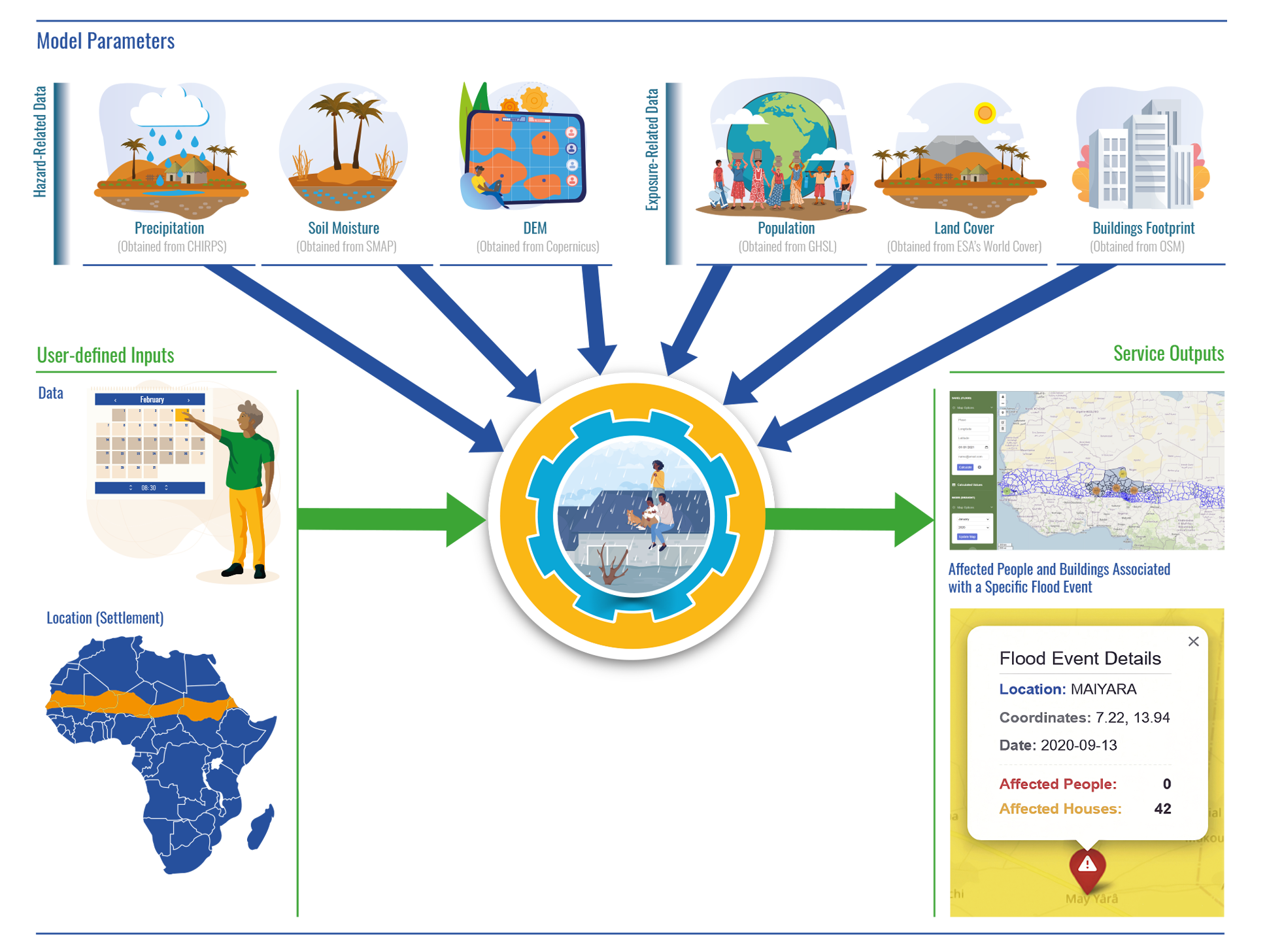
Automated estimation of flood-affected people and buildings in the Sahel. The tool integrates hazard data (DEM, CHIRPS, SMAP) and exposure data (ESA WorldCover, OSM, GHSL). A machine-learning model trained on DesInventar records predicts the number of affected people and buildings, while the outputs are numerical predictions.
Useful Resources:
- Policy Brief “Climate Security Watch: Advancing SDG Indicator 13.1.1 to Improve Disaster-Impact Assessment in the Sahel“
- Video Service Demonstration: click here
- Platform Guidelines: click here

The SDGs-EYES project is funded by the European Union | Credits