
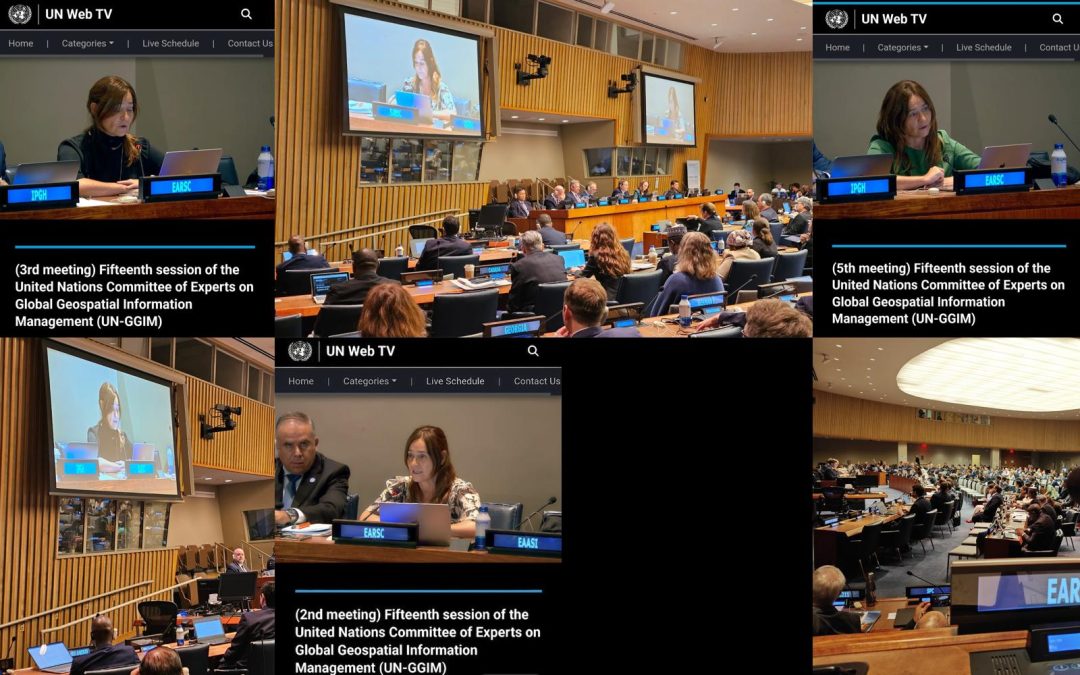
The 15th Session of the United Nations Committee of Experts on Global Geospatial Information Management (UN-GGIM), held in New York in August 2025, once again demonstrated the central role that geospatial data plays in shaping sustainable development. From climate resilience and disaster risk reduction to the evolving role of AI and the need for stronger governance, the discussions reaffirmed the transformative power of geospatial information in delivering the 2030 Agenda and informing the post-2030 framework.
The European Association of Remote Sensing Companies (EARSC), leading partner on liaison, co-design, and user uptake of the Horizon Europe–funded SDGsEYES project, was proud to contribute as an active observer.
Over the past years, Earth Observation has matured into a trusted, operational source of information for decision-makers. Through the integration of EO into the global geospatial ecosystem, persistent data gaps can be bridged, resilience strategies strengthened, and actionable insights delivered at multiple scales, from local communities to global reporting. Building on this vision, the SDGsEYES initiative demonstrates how Copernicus-based solutions can be embedded into national and regional workflows to support interconnected UN Sustainable Development Goals, particularly Climate (SDG 13), Ocean (SDG 14), and Land (SDG 15).
The discussions in New York made clear that progress will require more than technology, it needs robust frameworks that guide countries in embedding geospatial information into their governance systems. Here, SDGsEYES provides a bridge:
- linking EO services with the workflows of National Statistical Offices (NSOs), SDGsEYES supports the integration of geospatial and statistical data, a core requirement for accurate SDG reporting.
- ensuring that EO innovations are scalable, sustainable, and interoperable, empowering Member States to institutionalise EO within their national systems.
- promoting the support of frameworks for official statistics, enhancing interoperability between satellite data, GIS, and national statistical systems.
- supporting key stakeholders in developing the skills and confidence to integrate Copernicus data into their official workflows.
Projects like SDGsEYES remain committed to supporting the implementation of the UN2030 agenda. More information on the outcomes of the UN-GGIM 15th Session is available at the UN-GGIM website.