
Extreme temperatures risk – City of Turin (Italy)
| Alternative: Extreme temperatures risk in the city of Turin (Italy) |
| SDG: Climate Action |
|
Indicator: Mean near surface temperature deviation (urban) (ESS code: 13_30) Close UN indicator: 13.1.1 |
Copernicus components that will be used:   |
| Area description: Turin (45°6′ 58′′ N and 7°44′ 33′′ E) is located in the north-west part of Italy, and it is the fourth largest Italian urban area with a population of 852.223 inhabitants. The city is located 800 ft above sea level and despite the climate predominantly being characterised by dry summers and mild wet winters (Mediterranean), the presence of the Alpine Mountain range and the Superga hills favours a limited circulation of the foehn winds, conferring to Turin a complex mosaic of microclimates.s |
| Rationale: In a scenario of no or limited adaptation to climate change, extreme temperatures are expected to be one of the main adverse events responsible for additional deaths (Ballester et al., 2011). The Pilot therefore intends to demonstrate the effectiveness of the proposed improvements to the current assessment framework for the SDG indicator 13_30, which is used to monitor progress towards SDG 13 “Climate Action”. To do so, the use of high-resolution climate datasets on past climate – available on Copernicus as well as on other platforms/sources – will be analysed together with health data (to determine how the application and use of diverse climate data (in terms of time and space resolution) could improve the risk assessment phase and, then, support policymakers at the urban scale. In addition, this Pilot also has interconnection with other SDGs: first SDG 3 “Good Health and Well-being”, SDG 10 (“Reduced Inequalities”), because ASLTO3 could provide health data associated to demo-socio-economic data by location (Costa et al., 2017), and SDG 11 (“Sustainable Cities and Communities”), because, with these analyses, ad hoc adaptation measures could be implemented at the local scale to increase health resilience of local population. |
| Applications: (currently not applicable) |
|
Leader: ASLTO3 Partners: CMCC |
|
Main stakeholders involved Arpa Piemonte (The Regional Agency for the Protection of the Environment) Civil Protection Turin Municipal Administration Other regional and local decision-makers in health and social policies and institutions Active citizenship University of Turin (Interuniversity Department of Regional and Urban Studies and Planning) |
| Objectives: To best define which climate indicators could be used within a risk framework that takes into account the link between temperature and health (i.e. mortality, morbidity). This will be done by taking into account the different scales of spatial resolution, but also all demographic, socio-economic and built environment components that contribute to exacerbating (or mitigating) the final population risk from extreme temperature events in urban settings. |
|
Expected results & outcomes: The Pilot will deliver a Copernicus-based tool distributing maps of the mean near-surface temperature deviation, but more importantly of risk estimates, based on the multiple climate datasets. A DSS will allow users to query the maps and analyse data, including comparing different periods. The outcome will be a better understanding whether the use of higher resolution datasets favours more accurate or different risk estimates, which can support health policy-making processes related to the temperature-related risk management of the population at the urban scale. |
| References: Ballester et al. (2011) Doi:10.1038/ncomms1360; Costa et al. (2017); De Ridder et al. (2015) Doi:10.1016/j.uclim.2015.01.001; Ellena et al. (2020) Doi:10.1186/s12940-020-00667-x; Martinez et al. (2021) ISBN 978-92-890-5540-6; Raffa et al. (2021) Doi:10.3390/data6080088 |

Call for abstracts: SDGs-EYES Session in EGU24 (Vienna 14 – 19 April 2024 and Online)
On 14th to 19th of April 2024 in Vienna, CMCC and EARSC are organising a session within the EGU24 to collect contributions on how to make use of Earth Observations data to address SDG monitoring and reporting. The deadline to submit the abstract is: 10 January 2024, 13:00 CET.

SatCen is teaming up with EUSPA – EU Agency for the Space Programme and World Food Programme
SDGs-EYES partner SatCen is teaming up with EUSPA – EU Agency for the Space Programme and World Food Programme to host two Community Contributed sessions during the “International Geoscience and Remote Sensing Symposium – IGARSS 2024” in Athens, #Greece, from July 7th to 12th, 2024.

SATCEN participated to the first Climate Security Conference at the UN Campus in Bonn
In response to the ongoing climate crisis and the pursuit of Sustainable Development Goals (SDGs) and the UN 2030 agenda, UNITAR, together with Universitat Oberta de Catalunya, Technological University Dublin and World Association for Disaster and Emergency Medicine (WADEM), organised the first Climate Security International Research conference.
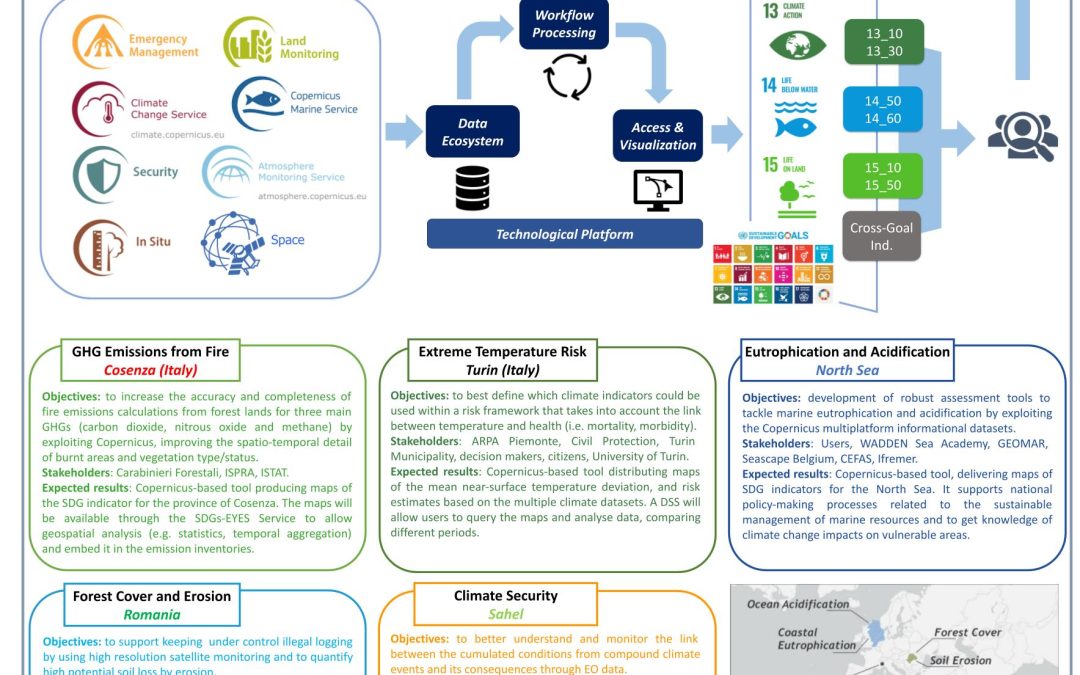
Attending ESA’s Science for a Green and Sustainable Society Initiative
Represented by its Project Coordinator (Marco Maninci – CMCC), SDGs-EYES attended the EC-ESA Joint Earth System Science Initiative Science for a Green and Sustainable Society.

SDGs-EYES at the AGU Annual Meeting 2023
On 11-15 of December 2023, SDGs-EYES will be presented at the AGU Annual Meeting 2023 in San Francisco, to share knowledge and research with scientists, educators, policymakers, journalists and communicators.

Unlocking the Potential of Earth Observations: A Recap of SDGsEYES Participation at the GEO Ministerial
The recent GEO Week 2023 side workshop, titled “Earth Observations in Support of the Sustainable Development Goals: Opportunities and Challenges” brought together experts to explore the role of Earth observations and geospatial data in advancing the Sustainable Development Goals (SDGs).

SDGs-EYES partners gathered in Rome for the 2nd project General Assembly
From 22 to 23 November 2023, CMCC hosted the second General Assembly of the SDGs-EYES project in Rome. This meeting served as a moment for partners to come together, share updates, delve into the project’s progress and explore the various pilot activities.

SDGs-EYES at the UNITAR Climate Security Conference
SatCen will presents the climate security scenario developed within European Commission projects as The Global Earth Monitor Project (GEM) and SDGs-EYES.
SDGs-EYES at the EC-ESA Joint Earth System Science Initiative Science for a Green and Sustainable Society
On 22-24 of November 2023, SDGs-EYES will present a poster in the session “Climate adaptation – Extremes, multi-hazards, and compound events”.
SDGs-EYES at the GEOweek2023 in Cape Town
On 7th of November 2023, SDGs-EYES will be presented during the session “Earth Observations in Support of the Sustainable Development Goals: Opportunities and Challenges” under the GEOweek 2023.
